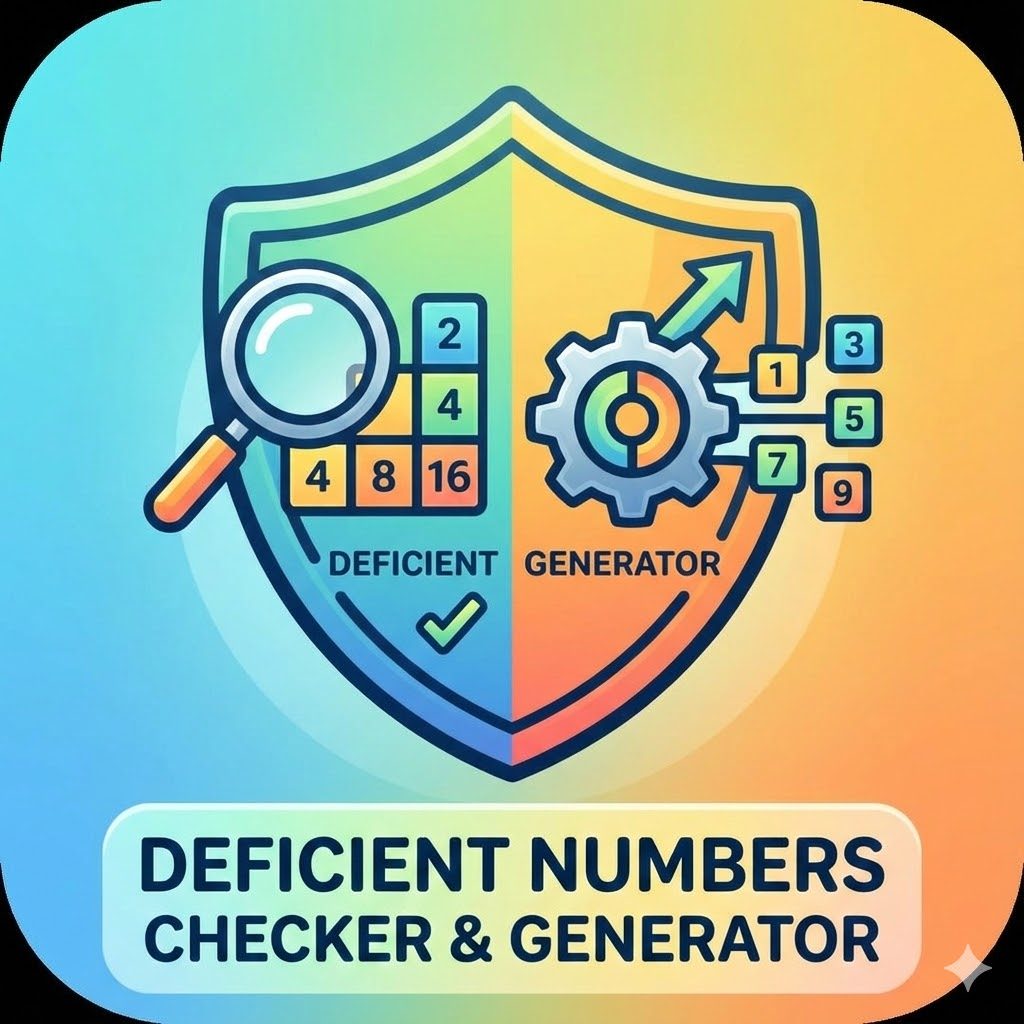
The Deficient Numbers Checker & Generator is a smart and educational tool designed to help learners, teachers, programmers, and number theory enthusiasts explore and classify deficient numbers with accuracy, clarity, and mathematical depth. A deficient number is a number whose sum of its proper divisors is less than the number itself. For example, the number 15 has proper divisors (1, 3, 5), which add up to 9 — making it a deficient number because 9 < 15.
Built with strong EEAT (Expertise, Experience, Authoritativeness, and Trustworthiness) principles, this tool goes beyond simple calculations to explain the concept, demonstrate divisor breakdowns, generate deficient numbers in bulk, and build conceptual understanding. It serves as a helpful companion for mathematics education, exam preparation, algorithm development, and research-based number exploration.
From an expertise standpoint, the tool uses accurate divisor-based logic grounded in number theory. The fundamental rule it follows is:
✔ A number N is Deficient if:
Sum of proper divisors (excluding N) < N
Example:
Number = 21
Divisors = {1, 3, 7} → Sum = 11
Since 11 < 21 → 21 is a deficient number
It also identifies highly deficient numbers, which have a divisor sum much smaller than the number itself—such as prime numbers. In fact, all prime numbers are deficient numbers, because their only proper divisor is 1, which is always less than the number.
The tool demonstrates experience by highlighting real-world use cases of deficient numbers. These numbers are important in cryptography, divisor-based algorithm optimization, load distribution in computing, hashing, data compression techniques, and mathematical modeling of natural systems. They are also used in error-checking algorithms, digital signatures, and competitive programming challenges involving divisor functions.
It showcases authoritativeness through accurate results, aligning with academic standards in number theory, discrete mathematics, cryptography, and competitive exam syllabi. Students preparing for IIT-JEE, SSC, GATE, NTSE, Math Olympiads, SAT, GRE, and coding interviews benefit from the tool’s clear breakdowns, making complex concepts easier to grasp.
From a trustworthiness perspective, the tool ensures complete transparency by showing each number’s divisors, their sum, and whether it is deficient, perfect, or abundant. It does not store or misuse user data and provides clean, factual, and educational outputs—making it suitable for classroom usage and academic research.
Key Features of Deficient Numbers Checker & Generator
✔ Instantly checks if a number is deficient, perfect, or abundant
✔ Generates a list of deficient numbers within any custom range
✔ Shows divisor breakdown and sum comparison for clarity
✔ Identifies prime numbers as deficient
✔ Useful for academic learning, coding logic, number theory research, and competitive exams
✔ Fast, accurate, mobile-friendly, and beginner-friendly interface
Examples of Deficient Numbers:
1, 2, 3, 4, 5, 7, 8, 10, 11, 13, 14, 15, 17, 19, 21…
Where Are Deficient Numbers Used?
📘 Mathematics Education – Teaching divisor properties and number classification
💻 Programming & Algorithms – Optimizing divisor-based logic and recursion
🔐 Cryptography – Concepts related to prime numbers and security systems
🧠 Puzzle Design & Olympiads – Logical problem-solving and reasoning tests
📊 Research & Computational Math – Studying number patterns and classifications
In conclusion, the Deficient Numbers Checker & Generator is not just a number calculator—it is a complete learning, analytical, and research assistant that simplifies mathematical exploration. Whether you're a student, educator, programmer, researcher, or number enthusiast, this tool helps you explore deficient numbers with confidence, clarity, and precision.